Ambrose Roanhorse — Navajo Silversmith & His Hallmark
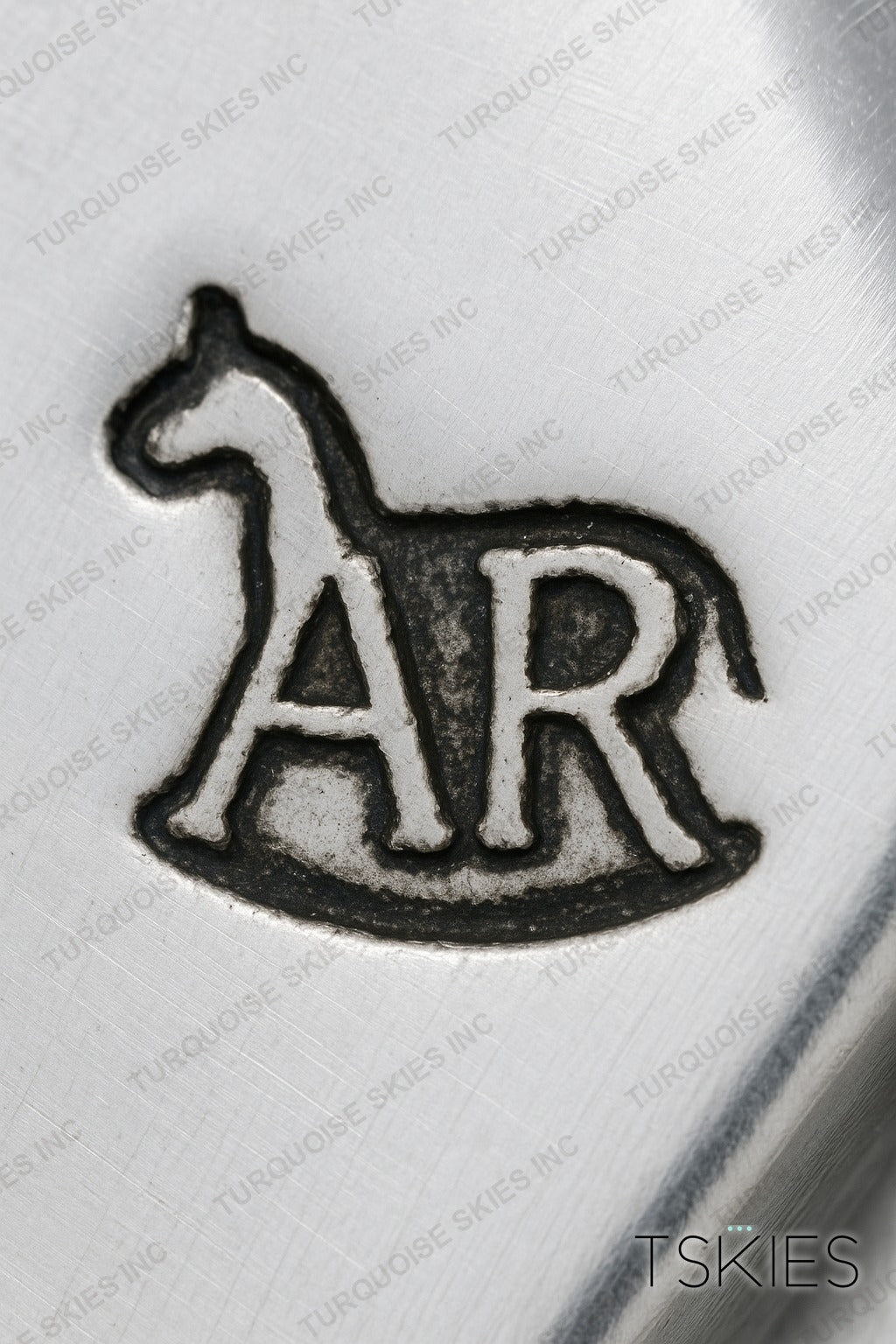
Ambrose Roanhorse's documented mark — AR formed into a rocking-horse shape (1950s) — recreated on sterling silver. © Turquoise Skies Inc. Not a photograph of an original Roanhorse piece.
Diné (Navajo) · c. 1904 – 1982 · Active c. 1930 to 1982
The marks
Hougart's reference documents one mark for Ambrose Roanhorse: AR (used in 1950s; formed into a rocking horse shape) — the letters bent into a rocking horse, a quiet play on his name. That's it. One mark, adopted two decades into a career that began around 1930, which means a great deal of his working life predates any personal stamp at all.
Collector's caution — read before you attribute. Earlier reference books — including earlier editions of Hougart's own — attributed a second mark to Roanhorse: a letter A inside a keystone or broken arrow point. That mark belongs to Ambrose Lincoln, a different Navajo silversmith working at the same time; the corrected attribution was published in Bahti (1980) and Messier (2014). The confusion ran deep enough that the two Ambroses were once mistakenly identified as the same person — Roger Skeet Jr., who knew both men, confirmed they were contemporaries, and both attended the 1954 Ceremonial at Gallup. On top of the mix-up, Hougart adds a flat warning on the Roanhorse entry: "Beware of fake hallmarks." A famous name, a single late mark, and a documented history of mis-attribution — if a piece matters, verify the AR rocking horse against the photographed examples in Hougart before you pay for the name.
The teacher who carried the old style back
He was born around 1904 in the Fort Wingate area as Ambrose Roans — he and his brother Sam took the surname Roanhorse sometime after 1938; as late as April of that year the director of the Indian Arts and Crafts Board was still addressing him as "Roans" in correspondence. He learned the basics of silver from his grandfather: pouring beads, hammering — "hammer the main thing," as his own recorded words from 1936 put it. That same 1936 statement predicted that machine-made jewelry would eventually overwhelm Native silversmiths, and Hougart opens the entire fifth edition of his hallmark reference with it, calling the prediction accurate.
In the 1930s Roanhorse worked for C. G. Wallace, Charles Kelsey, and Southwest Arts & Crafts, and in 1931 — the year silversmithing programs opened at the Fort Wingate, Santa Fe, and Albuquerque Indian schools — he became silversmith instructor at the Santa Fe Indian School, where he taught until 1939. (One IACB record says he was "borrowed from the Albuquerque Indian School" in 1937; the sources never reconcile the two schools, so neither will we.) His students crossed tribal lines: Leo Coriz of Kewa; the Hopi smith Lewis Lomay, who went on to Frank Patania's Thunderbird Shop in Santa Fe; Allen Kee, later of the White Hogan alongside his cousin Kenneth Begay; his brother Sam; Dooley Shorty; Chester Yellowhair. Hougart's verdict: perhaps the best-known teacher of traditional Navajo silver crafts in the past century.
But Roanhorse didn't just teach from a classroom. In 1937 the IACB sent him out as a roaming ambassador to carry the "old style" — hand-wrought ingot work, the techniques that predated the tourist trade — back to smiths at remote trading posts. At Pine Springs he encouraged Tom Burnsides and several others to work in the old way. On one tour he counted the smiths as he went: 29 Navajo women, 63 Navajo men, 46 Zuni men across four posts. When smiths at Pine Springs spotted mechanical rollers, Roanhorse wrote to IACB director René d'Harnoncourt, who backed him without hedging: "No piece of jewelry made with rollers can bear the Government mark."
In 1939 he demonstrated traditional techniques at the Golden Gate International Exposition and was appointed director of the newly formed Wingate Guild. He built outward from there — a salesroom selling Guild and school silver, Guild centers at Window Rock, Toadlena, and Shiprock, a Pine Springs facility in 1942 — and when the Navajo Arts and Crafts Guild was formally organized in September 1941, his Wingate Guild became its nucleus. He and Chester Yellowhair served on the committee that formed it, working alongside early Guild figures like Fred Peshlakai to give Indian-school graduates a real marketplace.
And here is the part collectors should sit with: Roanhorse is at the literal origin of the hallmark system this directory exists to document. He made the prototype dies for the IACB's stamp program, argued the naja was the wrong symbol for a Navajo mark, and pushed for smaller stamps applied letter by letter because the early dies damaged the silver. In 1940 Kenneth Chapman sent the official stamps to Roanhorse and Dooley Shorty for use with their students; within months, smiths outside the schools were stamping their own initials on their own initiative. What became of Roanhorse's homemade prototypes, Hougart says plainly, is unknown.
The honors came later: Hougart records the Palmes Académiques from the French Republic in 1954, among the first Native Americans so honored; work in the collection of the Museum of the American Indian in New York; and the Navajo title Beshlakai Natani — the leading silversmith of the Navajo Nation. But the neatest summary of the man is in the marks themselves. Ambrose Roanhorse built the stamping system that taught Native silversmiths to sign their work — and didn't get around to a mark of his own until the 1950s. The man who made the stamps for everyone else stamped himself last.
References
- Hougart, Bille. Native American and Southwestern Silver Hallmarks, 5th ed. (2022), Names section (Roanhorse and Ambrose Lincoln entries), IACB history sections, and timeline.
- Adair, John. The Navajo and Pueblo Silversmiths (1944), p. 57 and Appendix (Guild sections).
- Bedinger, Margery. Indian Silver: Navajo and Pueblo Jewelers (1973) — includes a cast ring by Roanhorse in the Bedinger Collection, University of Colorado Museum.
- Wright, Margaret. Hopi Silver — Lewis Lomay entry.
- Attribution corrections cited in Hougart: Bahti (1980); Messier (2014); Bahti (2007, Roger Skeet Jr. interview).