Fred Peshlakai — Navajo Silversmith & His Hallmarks
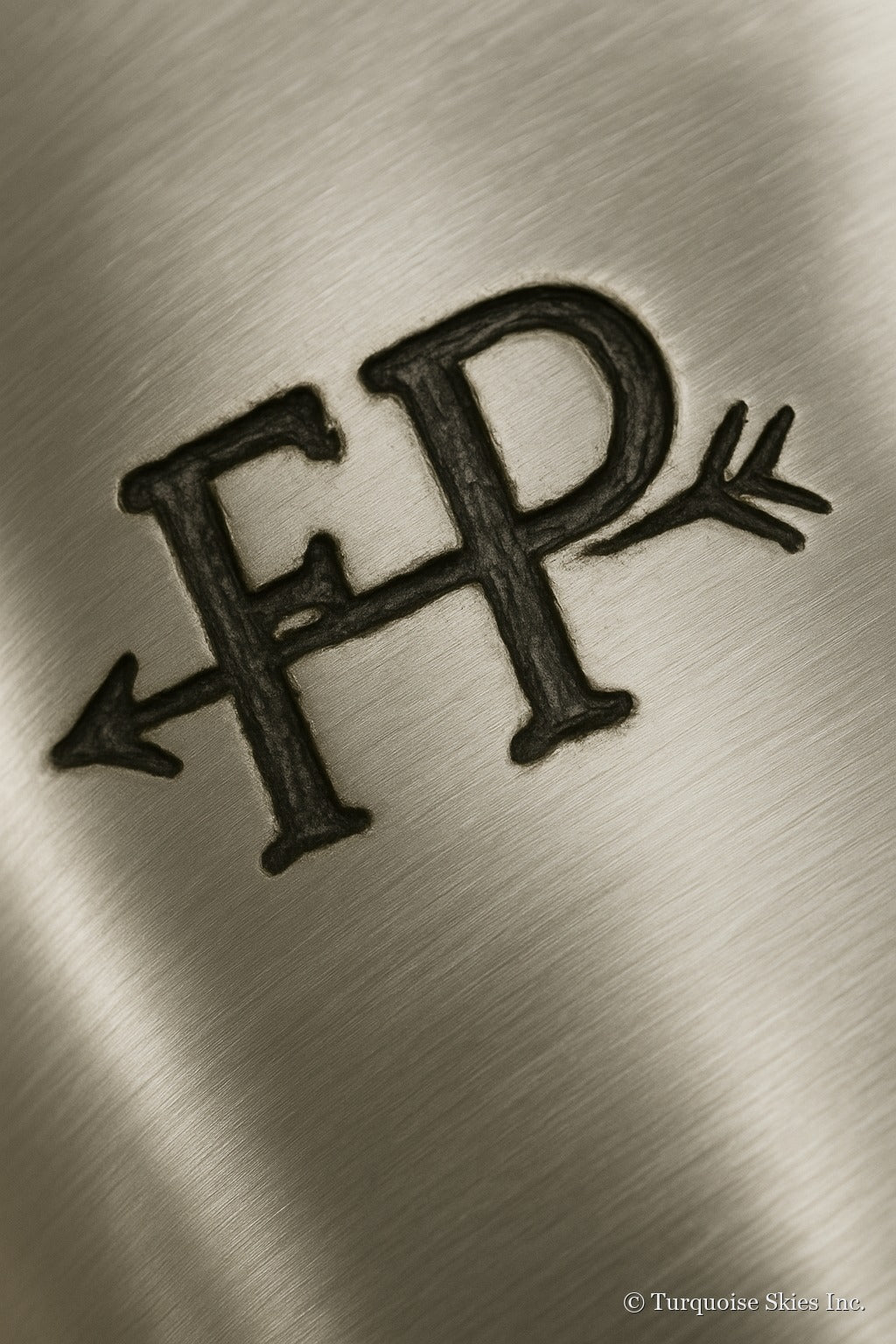
Fred Peshlakai's documented mark — FP on a left-facing arrow — recreated on sterling silver. © Turquoise Skies Inc. Not a photograph of an original Peshlakai piece.
Diné (Navajo) · c. 1896 – 1974 · Active mid-1920s to 1970
The marks
Fred Peshlakai was one of the earliest Native American silversmiths to stamp his own initials into his work — a practice so universal today that it’s easy to forget someone had to start it. Hougart’s reference documents five marks attributed to him:
- F. P inside a rattlesnake figure
- F. P. with a rounded or squared P
- F P superimposed on a short, left-facing arrow (1960s–c. 1973)
- FP superimposed on a long, left-facing arrow
- F. PESHLAKAI in chopped letters with a square P
Collector’s caution — read before you attribute.
Fred’s younger brother and student, Frank Peshlakai (1903–1965), also stamped F. P. on work strikingly similar in style — the two worked together in Los Angeles for a time, and assigning an F.P.-marked piece to either brother is, in Hougart’s words, “highly speculative.” A square-P mark leans Fred. The arrow marks vary too: split or hatched points, and shafts that pass through — or stop short of — the initials. At least one fake Fred Peshlakai mark is documented in the reference literature. If a piece matters, check it against Curtis’s dedicated study of his marks before you pay for the name.
The smith between two eras
If you drew Navajo silversmithing as a single unbroken line — from the first generation of smiths in the 1800s to the modernists of the post-war era — the line would pass through Fred Peshlakai.
He was born around 1896 into the craft’s founding family: his father’s household was that of Slender Maker of Silver (Peshlakai Atsidi, d. 1916), among the most celebrated of the first-generation Navajo smiths — though Adair, who interviewed Fred in Los Angeles, noted that Navajo kinship terms don’t distinguish son from nephew, so the exact relation stays honest scholars’ territory. The family name itself is the Navajo word for silver. Fred told Adair his father ran a true working shop, paying more than ten men — a production silversmithing operation decades before “production” was a word anyone attached to Indian jewelry.
Fred learned at that bench as a teenager, and by 1931 he was teaching at the Fort Wingate Indian School — where one of his students was a young Kenneth Begay, later celebrated as the father of modern Navajo silverwork. Begay remembered it plainly: “Fred Peshlakai taught us the old Navajo style that he learned from Slender Maker of Silver.” Students started on copper, filing and chiseling, melted scrap silver at a forge, and cut their own steel dies — the old way, taught whole.
In the early 1940s he helped the new Navajo Arts and Crafts Guild give Indian-school graduates a marketplace for their skills. By then Fred had carried the craft somewhere unexpected: Olvera Street in Los Angeles, where he ran a shop making Navajo silver in full public view — an ambassador working the bench where tourists could watch. In 1954 the Indian Center of Los Angeles awarded him first place in its Arts and Crafts exhibit. One more thread runs forward: the hogan stamp used from 1948 by White Hogan Silver — the Scottsdale shop Begay made famous — was reportedly acquired from Fred, though Hougart notes no firm evidence Fred ever stamped a hogan on his own work. Like the best hallmark stories, it ends in a careful maybe.
Slender Maker of Silver to Fred Peshlakai to Kenneth Begay: three names, one line, the whole first century of Navajo silver.
References
- Hougart, Bille. Native American and Southwestern Silver Hallmarks, 5th ed. (2022) — Names section (Peshlakai entries) and White Hogan Silver entry.
- Adair, John. The Navajo and Pueblo Silversmiths (1944), pp. 33–34.
- Bedinger, Margery. Indian Silver: Navajo and Pueblo Jewelers (1973).
- Rosnek, Carl & Stacey, Joseph. Skystone and Silver (1976), Kenneth Begay section.
- Further reading: Curtis, Steven. Navajo Silversmith Fred Peshlakai — the comprehensive study of his marks.