Leekya Deyuse — Zuni Carver & How His Work Is Attributed
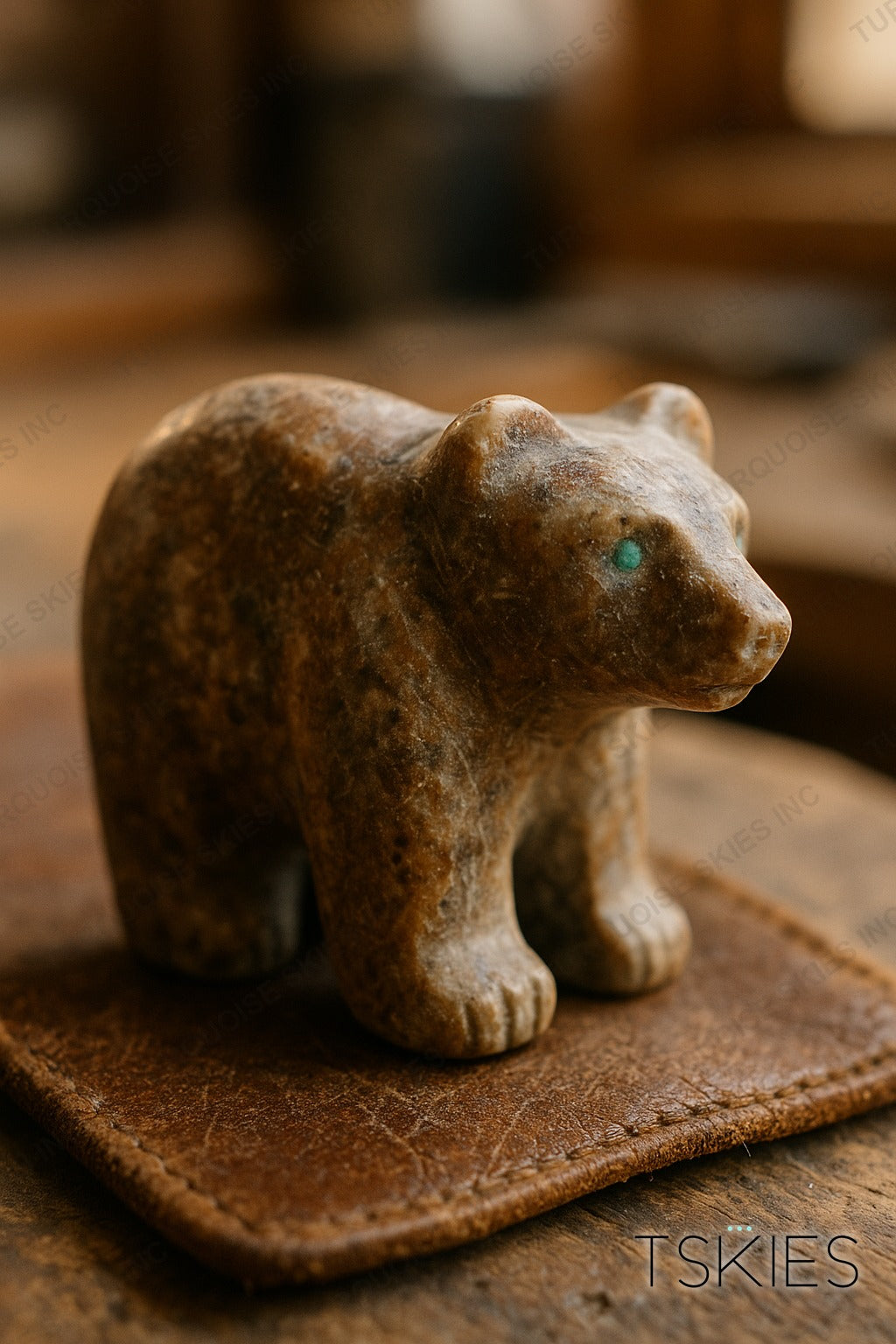
Concept image: a classic Zuni-style carved bear — Leekya Deyuse used no hallmark; his work is attributed by style. Not a photograph of a Leekya carving. © Turquoise Skies Inc.
Zuni Pueblo · Carver & lapidary
The attribution
In a directory built around hallmarks, Leekya Deyuse defines the second rule of collecting: some of the most sought-after names in Southwest jewelry never stamped anything at all. Hougart's hallmark reference has no mark entry for Leekya himself — he appears only as the named father and grandfather in his children's and grandchildren's entries. Attribution rests entirely on the eye, and by the 1970s the eye was considered enough. Rosnek and Stacey record a gallery dealer sorting fetish necklaces carving by carving: "You can say: this is a Leekya; that's a Mary Tsekewa: this one's an Andy Sr. and that's a David." Leekya was one of only a few carvers recognizable from the carving itself, or from the way a piece was strung.
Collector's caution — read before you attribute. The same source records the harder sentence: he "was not above buying fetishes from other carvers and selling them as his own, some necklaces which were sold by him aren't necessarily his work." So a "Leekya-attributed" piece earns skepticism twice over — there is no mark to check, and there is a documented history of other carvers' work passing through his hands under his name. What is documented in Hougart are the family marks: son Francis Leekya stamped a bird head, and an LF with the F nested within; son Robert Leekya used a conjoined RL, and an RLB shared with his wife Bernice (the larger L extends below the B); daughter Sarah Leekya marked S. Leekya; daughter Alice Leekya Homer, AL H; granddaughter Jobeth Mayes, her name in script (and Zuni Maize etched around a corn stalk). A marked Leekya piece is family work — not the elder's.
The carver in the middle
The Zunis, Adair wrote in 1944, "have known the art of carving turquoise for hundreds of years" — small blue stones shaped into animal forms and worn between the nuggets of necklaces. What Leekya joined was the commercial outgrowth of that ancient practice, which Adair dated to roughly the mid-1920s onward and documented while it was happening: the trader supplied the turquoise, shell, and jet, paid the carver by the piece, then handed the finished stone to a Navajo silversmith to mount. "The trader is the one who suggests the form of the finished piece to the craftsmen." Three parties, one object — and Leekya sat at the center of the triangle. "Two of the most expert turquoise-workers in the village," Adair reported, "are Ted Wiakwe and Leekya," and traders commissioned those two by name for carving in the round: animal figures as small as half an inch, "delicately molded." (One caveat: Bedinger, writing in 1973, pairs Wiakwe with "Robert Leekya" — which may refer to the son.)
Adair's photo caption calls him "Leekya, Zuni turquoise-worker," but he was a smith as well — he made most of his wife's jewelry and his own, and his own was a statement: over $3,000 worth of turquoise beads of his own making at his neck, a bracelet whose center stone was carved into a toad, another set with a single stone over three inches wide. Adair photographed the couple "dressed in the height of fashion."
His finish work became the connoisseur's tell. Carving shell birds, "the ripples in the material would suggest feathers and other features. His pieces are also incredibly finished. There are no rough edges." No source states outright that Leekya worked for C. G. Wallace — the connection is the trading-post ecosystem itself — but when Wallace's collection went to auction, over 1,100 lots of jewelry, the Leekya turquoise fetishes and fetish necklaces were among the actively contested lots.
The line held. Four children — Francis, Robert, Sarah, and Alice Leekya Homer — became documented working artists with their own marks, and granddaughter Jobeth Mayes carried it into a third generation from 1971 on. Rosnek and Stacey list Robert alongside Charles Loloma and Kenneth Begay among the artists taking Indian jewelry into "a new dimension." For the stones themselves, and for the Zuni carving tradition behind them, see the Silversmith Directory — dedicated turquoise and Zuni style-guide pages are coming.
References
- Adair, John. The Navajo and Pueblo Silversmiths (1944), pp. 148–149, 155–156, and plate captions.
- Bedinger, Margery. Indian Silver: Navajo and Pueblo Jewelers (1973).
- Rosnek, Carl & Stacey, Joseph. Skystone and Silver: The Collector's Book of Southwest Indian Jewelry (1976).
- Hougart, Bille. Native American and Southwestern Silver Hallmarks, 5th ed. (2022) — Leekya family entries.